Why Day-Old Rice Behaves Differently in Your Body Than Fresh Rice
Quick Answer: When cooked rice cools, some of its starch recrystallises into a form your small intestine cannot digest - this is called retrogradation, and the result is resistant starch. It behaves less like a carbohydrate and more like a fibre: it feeds gut bacteria in the colon instead of turning into glucose in your bloodstream. Studies on cooked-then-cooled rice consistently find a lower blood glucose response than the same rice eaten fresh, and reheating does not undo the change.
It is not a magic trick and it does not make rice a free food. But it is real, it is free, and Korean cooking has been built around it for a very long time.
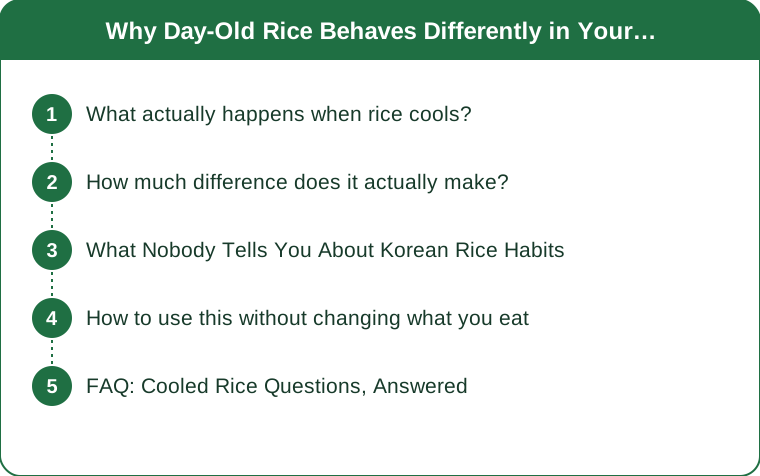
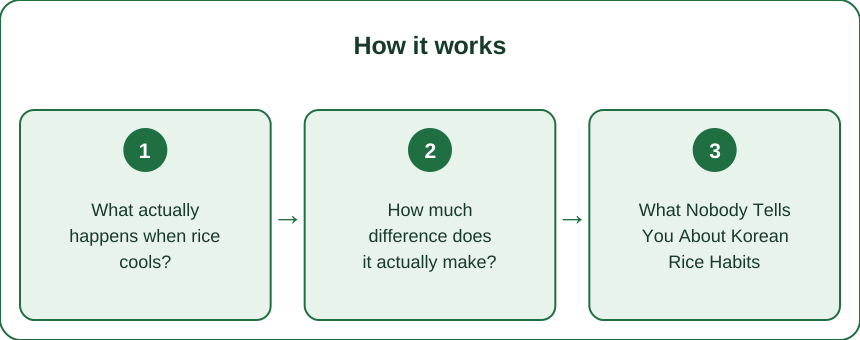
What actually happens when rice cools?
Cooking and cooling do two opposite things to starch, and the second one is the interesting part.
Cooking gelatinises. Heat and water break the tight crystalline structure of raw starch granules, which is exactly what makes cooked rice digestible and raw rice not. This is why fresh hot rice raises blood sugar efficiently - it is designed to be broken down quickly.
Cooling retrogrades. As the rice drops in temperature, some of those loosened starch chains - particularly the straight amylose ones - line back up and re-crystallise into a tighter structure. Your digestive enzymes cannot get at that structure. It passes through the small intestine unchanged.
What arrives in your colon is bacterial food. Gut bacteria ferment resistant starch and produce short-chain fatty acids, particularly butyrate, which is the preferred fuel of the cells lining your colon. This is the part nutrition researchers are most interested in, and it is a genuinely different outcome than glucose absorption.
Cold matters more than time. Refrigerator temperature drives the change far more effectively than leaving rice on the counter, and 12 to 24 hours captures most of the available effect. Freezing works too.
And reheating mostly does not reverse it. Some of the resistant starch converts back, but a meaningful portion stays resistant - which is why this is practical rather than theoretical. You are not required to eat cold rice.
How much difference does it actually make?
Enough to be worth doing, not enough to change what rice is. Both halves of that sentence matter.
The measurable effects reported in the research:
- Resistant starch content rises several-fold in cooked-then-cooled rice compared with freshly cooked
- Post-meal blood glucose response drops - studies vary in magnitude but the direction is consistent
- A modest reduction in available calories, because resistant starch yields roughly half the energy of digestible starch
- Improved satiety in some studies, likely a mix of the fermentation products and the slower glucose curve
What it does not do. It does not turn a large bowl of rice into a small one. The calorie difference is real but modest, and portion size still outranks preparation method by a wide margin. Anyone selling this as a weight-loss trick is overselling it.
Where it genuinely matters: if you eat rice daily - which describes most Korean households - a consistently lower glucose response across hundreds of meals a year is not a trivial thing. Small effects repeated constantly are how dietary patterns actually work.
The variety matters too. Higher-amylose rice retrogrades more, which means long-grain and some mixed grains produce more resistant starch than short-grain white rice. Adding barley or other grains to the pot - a very traditional move - shifts things further in the same direction.
What Nobody Tells You About Korean Rice Habits
The interesting part is that none of this was designed. It fell out of how people actually cook.
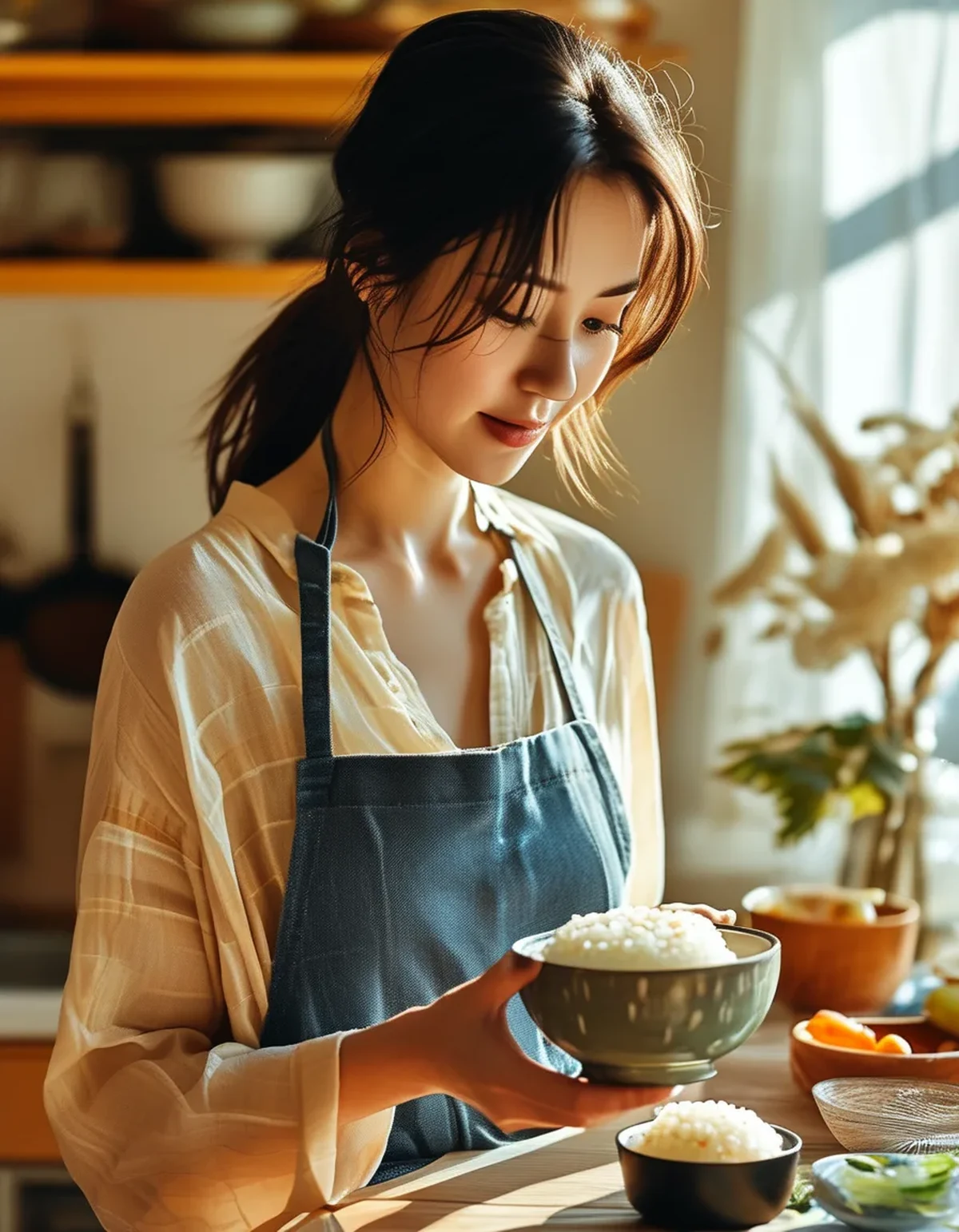
Batch cooking was practical long before it was nutritional. Cooking a large pot and portioning it means most Korean households are eating retrograded rice most of the time without ever having heard the word. The habit came from fuel and labour economics; the metabolic effect came along for free.
Frozen rice portions are the modern version. Portioning warm rice into containers, cooling, and freezing is now standard in a great many kitchens. This captures the effect and also fixes portion size, which is the bigger lever anyway.
Bokkeumbap exists because of it. Fried rice made with fresh rice turns to paste. Day-old rice fries properly precisely because the retrograded starch holds its structure - the same chemistry that resists your enzymes also resists turning to mush in the pan.
Banchan does the rest. A rice bowl eaten alongside fermented vegetables, soup, and protein produces a very different glucose curve than rice eaten alone, because fibre, acid, fat, and protein all slow gastric emptying. Kimchi’s acidity alone has a measurable effect on post-meal glucose.
And nurungji is the counterexample worth knowing. The scorched rice at the bottom of the pot is a different transformation entirely - that is browning, not retrogradation, and it does not carry the same effect. Delicious, but not the same mechanism.
How to use this without changing what you eat
The whole point is that this requires no discipline. It requires a container.
The practical version:
- Cook a full pot, not a single portion. Portion the extra while it is still warm into individual containers - roughly 150 to 200g each is a sensible bowl
- Cool it and refrigerate within an hour or two. Do not leave cooked rice at room temperature for hours - reheated rice food safety is a genuine concern, and the bacteria involved produce a toxin that reheating does not destroy
- Refrigerate 12 to 24 hours, or freeze. Freezing preserves the change and buys you weeks
- Reheat properly - steaming or microwaving with a splash of water, until steaming hot throughout, once only
- Eat it with the usual accompaniments. Soup, banchan, protein. The combination matters more than the rice alone
Push it further if you want: mix in barley, black rice, or beans at cooking. Multigrain rice raises fibre and resistant starch simultaneously and is entirely traditional.
One safety rule that overrides all of this: cool fast, store cold, reheat once, and do not keep cooked rice more than a few days. The metabolic benefit is not worth a food-safety shortcut, and this is the one place where the traditional habit needs a modern refrigerator to be safe.
If you manage diabetes or another condition where glucose response matters clinically, discuss changes with your care team rather than adjusting on your own. This is general information, not medical advice.
FAQ: Cooled Rice Questions, Answered
Does this work with other starches?
Yes - potatoes and pasta both retrograde in the same way, and cooled potato salad is a well-studied example. Rice gets the attention because of how often it is eaten in East Asian diets, not because it is uniquely responsive.
Is cold rice better than reheated rice for this?
Marginally, since reheating converts some resistant starch back. The difference is small enough that eating it hot is the right call for almost everyone - a habit you keep beats a slightly better one you abandon.
How long does rice need to be in the fridge?
Most of the change happens in the first 12 hours, and 24 hours captures effectively all of the practical benefit. Longer does not keep helping, and does raise food safety questions.
Does this mean I can eat more rice?
No, and this is where the idea usually goes wrong. The effect is a modest improvement to the same portion, not permission for a bigger one. Portion size still does most of the work.
TL;DR:
- Cooling cooked rice converts some starch into resistant starch your body cannot digest
- That starch feeds gut bacteria instead of raising blood glucose, and reheating mostly preserves it
- Effects are real but modest - a better version of the same portion, not a smaller one
- Batch cook, portion warm, chill or freeze, reheat once until steaming hot
- Multigrain rice and a proper banchan spread push the effect further
Cook double tonight and portion half into the fridge. You will get the effect tomorrow without doing anything differently at the table.
Keep Reading
This article is for general informational purposes only and is not medical advice. Always consult a qualified health professional for guidance specific to you.