Why Korean Stews Taste Saltier as They Cool
Quick Answer: The stew did not get saltier. Your perception of salt rises as food cools, because the TRPV1 and salt-sensing pathways on your tongue respond differently at different temperatures, and heat partially masks saltiness. Add the fact that a jjigae keeps reducing in a hot earthenware pot after it leaves the stove, concentrating everything by five to ten percent, and a stew seasoned perfectly at boiling will read as over-salted at eating temperature. Season for the temperature you will actually eat at.
You tasted it. It was right. You brought it to the table, talked for ten minutes, and now it tastes like the sea.
This happens to experienced cooks constantly, and there are two separate mechanisms stacking on top of each other.

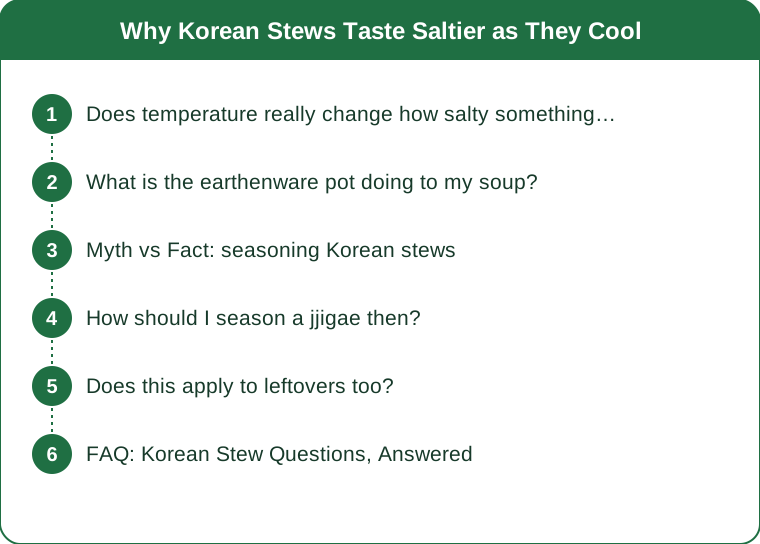
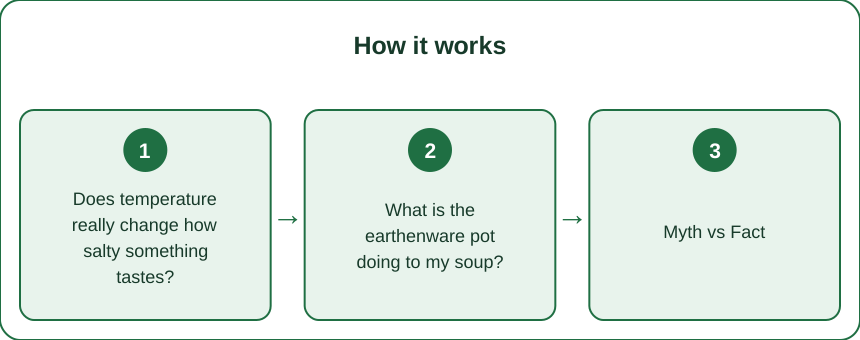
Does temperature really change how salty something tastes?
Yes, and the effect is larger than most home cooks assume. Taste receptor response is temperature-sensitive, and saltiness and bitterness both read stronger as food approaches room temperature while sweetness tends to read stronger warm.
This is why cold soup recipes are seasoned differently, why chilled naengmyeon broth tastes balanced cold and harsh warm, and why professional kitchens taste sauces at service temperature rather than straight off the heat.
The practical size of it: a stew seasoned to taste at near-boiling can read noticeably saltier at 60C and clearly over-salted at 40C. Nothing chemical changed in the pot. Your tongue changed.
What is the earthenware pot doing to my soup?
Ttukbaegi are prized because they hold heat, and holding heat means the stew keeps simmering at the table for several minutes after it leaves the burner.
Simmering is evaporation. Evaporation removes water and leaves the salt, the doenjang solids and the glutamates behind. A pot that reduces even five percent at the table has concentrated the seasoning by roughly that much.
So the two effects run in the same direction: the soup genuinely becomes more concentrated, and your palate simultaneously becomes more sensitive to salt as it cools. You are chasing a moving target from both ends.
A stainless pot with a wide surface loses heat faster and reduces less at the table. Different problem, different correction.
Myth vs Fact: seasoning Korean stews
Myth: Doenjang is doenjang, so a recipe amount is reliable. Fact: Sodium in commercial doenjang varies enormously brand to brand. Two tablespoons from one tub is not two tablespoons from another. Recipes are starting points.
Myth: You should salt at the end so you have control. Fact: With fermented pastes, late addition leaves a raw, sharp edge. Add the paste early, then adjust with a splash of broth rather than more salt.
Myth: Adding a potato pulls out salt. Fact: A potato absorbs seasoned liquid, so it dilutes what is left slightly. It does not selectively remove sodium. Adding unsalted broth does the same job faster.
Myth: If it tastes right hot, it is right. Fact: This is the actual error. Hot is the least reliable moment to judge a stew you plan to eat over twenty minutes.

How should I season a jjigae then?
Work backwards from the table, not forwards from the stove.
-
Season to about 90 percent of what tastes right at boiling. That last 10 percent arrives free as it cools and reduces.
-
Taste from a spoon that has sat for 20 seconds, not straight from the simmer. Twenty seconds is enough to drop it into the range where your palate reads salt honestly.
-
Keep unsalted broth or rice water at hand. Correcting a salty stew with plain water thins the body. Correcting with anchovy broth or the starchy water from rinsing rice keeps the texture.
-
Add tofu and vegetables before the final seasoning check. They release water and will dilute you after the fact if you season first.
-
If it is going in a ttukbaegi, pull it off the heat a minute earlier than feels right. It will finish itself at the table.
Does this apply to leftovers too?
Differently, and this is where the folk wisdom about day-two jjigae comes from.
Overnight, two more things happen. Salt and glutamates fully diffuse into the solids, so the tofu and vegetables that tasted bland now carry seasoning, and the broth reads slightly less concentrated even though nothing was removed. Meanwhile some volatile aromatics fade, which is why day-two stew is rounder but less bright.
The result is a stew that often tastes better balanced the next day despite being no less salty overall. That is redistribution, not reduction.
When you reheat, add a small splash of water before it comes back up to heat rather than after. Anything you add at the end sits on top instead of integrating.
FAQ: Korean Stew Questions, Answered
Why does restaurant jjigae taste balanced even when it is very salty?
Because it arrives with rice, banchan and a drinking soup that all buffer it, and it is served at a temperature that suppresses the salt reading. Eaten alone at room temperature, most restaurant jjigae would taste sharp.
Is there a way to fix an over-salted stew at the table?
Add rice directly to the bowl rather than eating it alongside. Starch absorbs seasoned liquid and drops the effective concentration per bite immediately.
Should I use low-sodium doenjang?
It behaves differently in fermentation-forward dishes and often tastes flat. Better to use regular paste and simply use less of it, then build depth with anchovy and kelp broth instead of more paste.
This is general information, not medical advice.
TL;DR:
- Cooling raises your perception of salt. The stew did not change, your palate did.
- Earthenware pots keep reducing at the table, concentrating seasoning by another five to ten percent.
- Season to about 90 percent at the stove and taste from a spoon that has cooled 20 seconds.
- Correct with unsalted broth, not water, and add rice at the table for an instant fix.
The cooks who nail this are not seasoning better, they are tasting at the right moment. Move your final taste twenty seconds later and most of the problem disappears before it reaches the table.
Keep Reading
This article is for general informational purposes only and is not medical advice. Always consult a qualified health professional for guidance specific to you.